U.S. Department of the Interior, Upper Colorado River Interagency Fire Management Unit, U.S. Forest Service, U.S. Department of Agriculture
The link above will allow you to view the memorial on a live stream video.
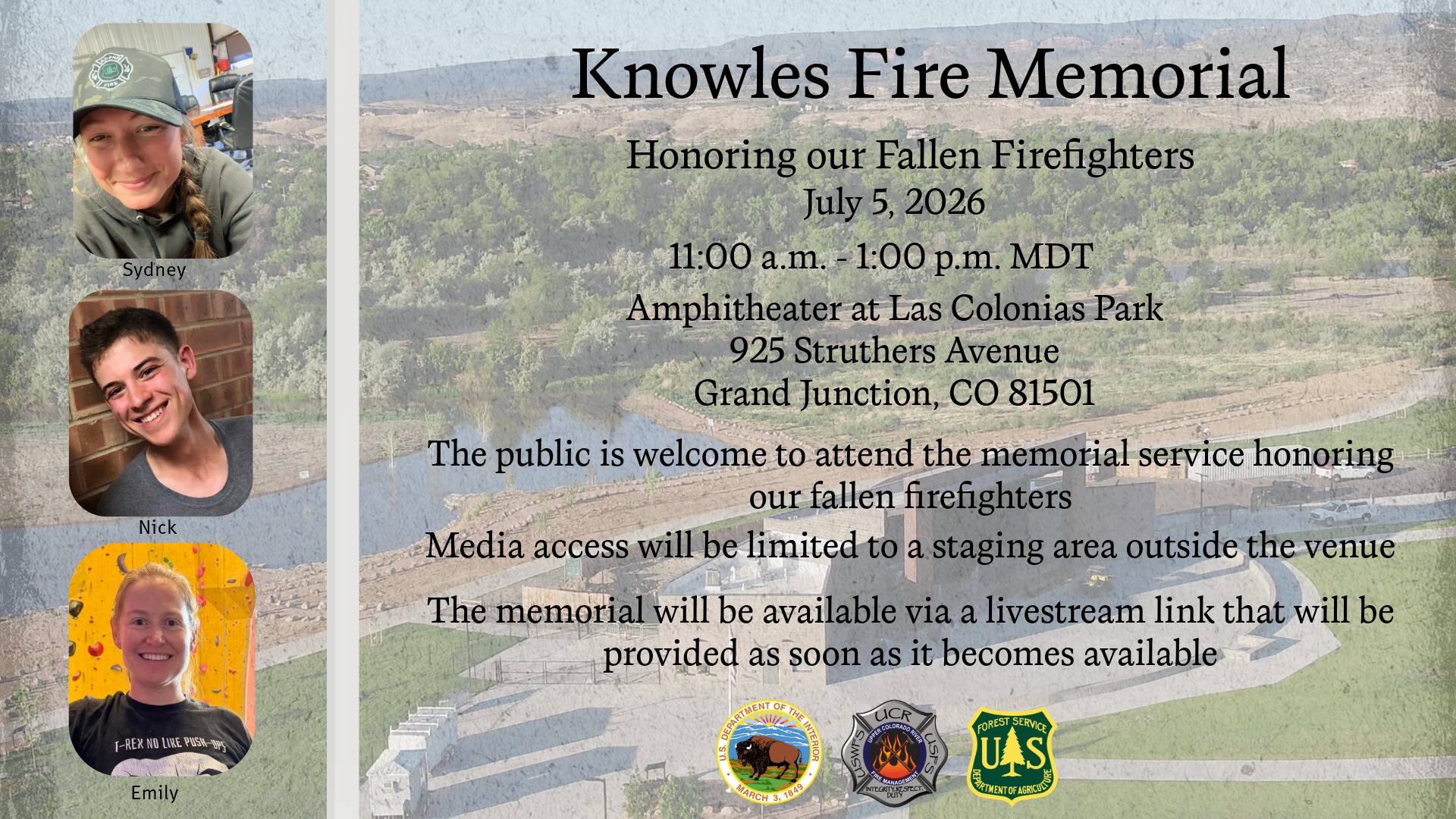
The public is welcome to attend the memorial service honoring our fallen firefighters who were engaged in initial attack operations on the Knowles Fire.
Emily Barker, assigned to the U.S. Forest Service Rifle Helitack.
Nick Hutcherson, assigned to the U.S. Forest Service Kaibab National Forest.
Sydney Watson, assigned to the U.S. Wildland Fire Service Rifle Helitack.
Knowles Fire Memorial
July 5, 2026 11:00 a.m. – 1:00 p.m. Amphitheater at Las Colonias Park 925 Struthers Avenue Grand Junction, CO 81501
Media access will be limited to a staging area outside the venue.
U.S. Department of the Interior, Upper Colorado River Interagency Fire Management Unit, U.S. Forest Service, U.S. Department of Agriculture
The public is welcome to attend the memorial service honoring our fallen firefighters who were engaged in initial attack operations on the Knowles Fire.
Emily Barker, assigned to the U.S. Forest Service Rifle Helitack.
Nick Hutcherson, assigned to the U.S. Forest Service Kaibab National Forest.
Sydney Watson, assigned to the U.S. Wildland Fire Service Rifle Helitack.
Knowles Fire Memorial
July 5, 2026 11:00 a.m. – 1:00 p.m. Amphitheater at Las Colonias Park 925 Struthers Avenue Grand Junction, CO 81501
Media access will be limited to a staging area outside the venue.
The memorial will be available via a livestream link that will be provided as soon as it becomes available.
U.S. Wildland Fire Service and U.S. Forest Service
We are saddened to share the identities of the three firefighters we lost responding to the Knowles Fire in western Colorado on Saturday. The firefighters were assigned to the Rifle Helitack crew and were engaged in initial attack operations on the Knowles Fire when the incident occurred.
The deceased firefighters have been identified as:
Emily Barker, 38, of Clinton Township, Michigan, assigned to the U.S. Forest Service Rifle Helitack.
Nick Hutcherson, 27 of Glendale, Arizona, assigned to the U.S. Forest Service Kaibab National Forest.
Sydney Watson, 27, of Warrior, Alabama, assigned to the U.S. Wildland Fire Service Rifle Helitack.
Two additional firefighters were injured during the incident and are receiving medical care.
“We mourn the loss of three firefighters who answered the call to protect others and made the ultimate sacrifice in service to their fellow citizens,” said U.S. Wildland Fire Service Chief Brian Fennessy. “Our thoughts are with their families, loved ones, friends and crewmates as they face an unimaginable loss. These firefighters embodied the courage, professionalism and selflessness that define the wildland fire service. Please join me and my family in keeping our thoughts and prayers with the families of the fallen and our injured firefighters and their families.”
U.S. WILDLAND FIRE SERVICE website | facebook @USWFS
Departments of the Interior and Agriculture coordinating support for families, crews and communities
MESA COUNTY, Colo. — Federal wildland fire officials are releasing the identities of three firefighters who died while responding to the Knowles Fire in western Colorado on Saturday.
The firefighters were assigned to the Rifle Helitack crew and were engaged in initial attack operations on the Knowles Fire when the incident occurred.
The deceased firefighters have been identified as:
Emily Barker, 38, of Clinton Township, Michigan, assigned to the U.S. Forest Service Rifle Helitack.
Nick Hutcherson, 27 of Glendale, Arizona, assigned to the U.S. Forest Service Kaibab National Forest.
Sydney Watson, 26, of Warrior, Alabama, assigned to the U.S. Wildland Fire Service Rifle Helitack.
Two additional firefighters were injured during the incident and are receiving medical care.
The Snyder Fire has merged with the Jones Fire and subsequently overtook the Knowles and Gore fires. All fire activity is now being managed and reported as the Snyder Fire. The fire is currently estimated at over 28,000 acres along the Colorado-Utah border.
An interagency complex incident management team has assumed command of the Snyder Fire.
“We mourn the loss of three firefighters who answered the call to protect others and made the ultimate sacrifice in service to their fellow citizens,” said U.S. Wildland Fire Service Chief Brian Fennessy. “Our thoughts are with their families, loved ones, friends and crewmates as they face an unimaginable loss. These firefighters embodied the courage, professionalism and selflessness that define the wildland fire service. Please join me and my family in keeping our thoughts and prayers with the families of the fallen and our injured firefighters and their families.”
“This is an incredibly difficult moment for the entire wildland fire community,” said Forest Service Deputy Chief Sarah Fisher. “Our heavy hearts are with the families during this unimaginable time. We recognize the tremendous impact this loss has on them and are deeply grateful for the devotion their loved ones brought to our organizations. We will honor their memory with compassion and support as their selfless service and commitment create an enduring legacy.”
The U.S. Department of the Interior’s Wildland Fire Service and the U.S. Department of Agriculture’s Forest Service are closely coordinating response efforts and providing support to the families, coworkers and loved ones of those affected by this tragedy.
A serious accident investigation team has been mobilized and is reviewing the circumstances surrounding the incident.
The wildland firefighting community mourns the loss of these firefighters. Additional information will be released as it becomes available.
June 23, 2026 – Garfield County, CO, the Garfield County Sheriff’s Office, Bureau of Land Management (BLM) lands, the U.S. Forest Service in Garfield County, and the seven Fire Districts in Garfield County are implementing Stage 2 Fire Restrictions effective at 1 a.m. Friday June 26, 2026. This applies to all of Garfield County.
This decision was made with thoughtful consideration. We look at the data as well as the potential for significant wildfires and balance it with the impacts to our community. The current active wildfires in Colorado have already stretched our available resources and effected our ability to respond as necessary.
Fire restrictions are implemented based on specific criteria to including moisture content of vegetation, weather outlooks, human risk factors, and firefighting resource availability.
What Stage 2 Fire Restrictions mean in Garfield County
A) Use of fireworks – Not permitted
B) Burn permits (General) – No burn permits will be issued. All previously issued burn permits are cancelled.
C) Recreational fires- No recreational fires
D) Cooking fires – Use caution and keep attended. Cooking devices must be clean (including gas cylinder) and in proper working order.
Gas Grills – No permit required.
Charcoal and other solid fuel grills and cookers – No permit required in developed areas only.
In undeveloped areas, a permit from the local fire department may be required.
E) Smoking – Open smoking allowed in developed areas.
In undeveloped areas, allowed only in an enclosed vehicle or building.
F) Welding and spark-emitting cutting (hot work) – Developed area: Use extreme caution and take preventative measures as necessary.
Undeveloped area: Industrial use only. A permit from the local fire department may be required. Must be in a cleared area at least 10 feet in diameter with a designated lookout. Must have Class A fire extinguishing capabilities readily available.
G) Operating of internal combustion engine-powered equipment, such as chainsaws, hand-held tools, or generators without a spark-arresting device is prohibited. If described equipment does have a spark arresting device, you must have Class A fire extinguishing capabilities readily available, and round-point shovel (36? length minimum) shall be readily available for use.
H) Other internal combustion engine-powered equipment, such as tractors and mowers: Operate with extreme caution paying special attention in areas subject to extreme conditions that may be susceptible to ignition (dry weeds and grasses, etc.).
I) Use of explosives, explosive targets and steel or tracer bullets – not permitted.
J) Use of firearms – steel jacket/core bullets (armor piercing) and tracer bullets are expressly prohibited. It is the responsibility of each independent range to ensure safe fire conditions at all times the range is in use. This includes: mitigating fuels that may potentially catch fire; monitoring downrange conditions/impacts; maintaining the ability to access and rapidly extinguish fires; notifying the local fire department immediately in the event of a fire of any size. Keeping a usable fire-extinguishing application method on hand is strongly recommended.
If shooting at an unattended range – including those on public and private property – the responsibility for ensuring safe fire conditions falls on the independent shooter.
By definition: A “developed area” is an area, whether within city limits or rural, that is groomed, manicured and or watered, where grasses, brush and trees are regularly attended to by landowner. This includes residential and business areas, improved recreational areas, parks and other common areas.
“Undeveloped areas” are lands that are not groomed, manicured, or watered; where grasses, brush and trees have been allowed to grow in a natural environment. This includes green belts that are not landscaped or manicured, open space lands, non-manicured parklands, and other areas where the fire hazard presented by the vegetation is determined by the authority having jurisdiction or designee to be an undue wildland fire hazard.
The mission of the Garfield County Sheriff’s Office is to provide solutions for the people through professional, ethical and compassionate conduct.
Garfield County, the Garfield County Sheriff’s Office, Bureau of Land Management (BLM), the U.S. Forest Service, and the seven fire districts in Garfield County are implementing Stage 1 fire restrictions effective at midnight on Thursday, June 26, 2025. This applies to all of Garfield County.
This decision was made with thoughtful consideration. We look at the data, the potential for significant wildfires, and balance it with the impacts to our community. Our concern, with the level of fire danger we are seeing; one spark could quickly spread into a dangerous wildfire threatening lives, property, and natural resources.
Fire restrictions are implemented based on specific criteria, including moisture content of vegetation, weather outlooks, human risk factors, and firefighting resource availability. It has been hot, dry, and unseasonably windy. So far this year, we have had several Red Flag warnings. The National Weather Service is forecasting above average temperatures and dry conditions with no relief from rain anytime soon.
With increasingly dry vegetation, severe drought conditions, and more hot and dry conditions approaching, the danger for human-caused wildfires increases even more.
What Stage I fire restrictions mean in Garfield CountyFireworks are not allowed under Stage I Fire Restrictions. Professional fireworks shows may be allowed through the permitting process.All burn permits are postponed/Canceled until further notice.Campfires are only allowed within designated fire grates in developed areas (i.e. a permanent in-ground containment structure or store bought fire pit) A temporary fire pan and rock campfire rings will not be acceptable.No fires of any type including charcoal in undeveloped areas.No smoking except within a designated area, enclosed vehicle or building, a developed area or in an area free of combustibles.No use of fireworks or explosive materials, including “exploding” targets or bullets and tracer rounds.Exercise common sense and industry safety practice when welding or operation of an acetylene or other similar torch with open flame always cleared safe area of vegetation and combustibles.
Penalties Causing a fire during fire restrictions can be a class 6 felony and can be punishable by fines. Other possible charges range from a Class 2 felony to a petty offense depending on the value of the damage caused. You may be held financially responsible for damage caused.
Federal lands The use of fireworks, flares, or other incendiary devices, including exploding targets, are always prohibited on Federal lands.
By definition: A “developed area” is an area, whether within city limits or rural, that is groomed, manicured and or watered, where grasses, brush and trees are regularly attended to by landowner. This includes residential and business areas, improved recreational areas, parks and other common areas.
An “undeveloped area” are lands that are not groomed, manicured, or watered, where grasses, brush and trees have been allowed to grow in a natural environment. This includes green belts that are not landscaped or manicured, open space lands, non-manicured park lands, and other areas where the fire hazard presented by the vegetation is determined by the authority having jurisdiction or designee to be an undue wildland fire hazard.
U.S. Forest Service and the Bureau of Land Management
White River National Forest and BLM Upper Colorado River District to enact stage 1 fire restrictions
June 25, 2025, 1:04 p.m. – GRAND JUNCTION, Colo. – All lands managed by the White River National Forest and the Bureau of Land Management Upper Colorado River District will be under stage 1 fire restrictions beginning Friday, June 27.
Under stage 1 restrictions for the Bureau of Land Management and White River National Forest:
campfires are only allowed within designated fire grates in developed campgrounds (including the Forest Service Homestake Valley designated dispersed camping sites in Eagle County); this means a metal, in-ground containment structure — fire pans and rock campfire rings are not acceptable.
no fires of any type including charcoal outside of developed areas
no smoking except within an enclosed vehicle or building, a developed recreation site or in a barren area free of vegetation
no use of explosive materials, including explosive targets
no welding or operation of an acetylene or other similar torch with open flame except from an area that has been cleared of vegetation
no operation of any internal combustion engine without a spark arresting device properly installed and in working order
Although conditions vary across the area, a longer-term drying trend is expected to continue.
“Fire restrictions are prudent at this time considering the long-range forecast, fuel moisture conditions on the ground, and the continued high public visitation,” said White River National Forest Supervisor Brian Glaspell. “In developed campgrounds where campfires are permitted, please ensure your fire is completely out and cold before leaving.”
“As we enter stage 1 fire restrictions, it’s crucial for everyone to understand the importance of fire safety during this dry season,” said BLM Upper Colorado River District Manager Greg Larson. “We urge all residents and visitors to be vigilant and responsible with any outdoor activities that could spark a fire. Remember, fireworks are not allowed on federal land.”
Officials consider several criteria when determining the need for fire restrictions, including current and anticipated fire danger, resource availability, and consistency with neighboring jurisdictions. Local, county, state and federal officials within this area evaluate and coordinate fire restrictions weekly during fire season.
BLM Grand Junction and Colorado River Valley Field Offices, part of the BLM Upper Colorado River District, and unincorporated private lands in Eagle, Garfield, Mesa, Pitkin and Summit counties will also enter fire restrictions this week.